Start with context.
Bring flagged concerns and their records into one queue and case workspace. The aim is less switching between tools and less rebuilding the same picture from scratch.

Support for the people
who protect children online.
A connected workspace for reviewing concerns, assessing conversations, and preserving the record. Designed to take repetitive work off an operator’s shoulders while keeping consequential decisions in human hands.
Working demonstration · In development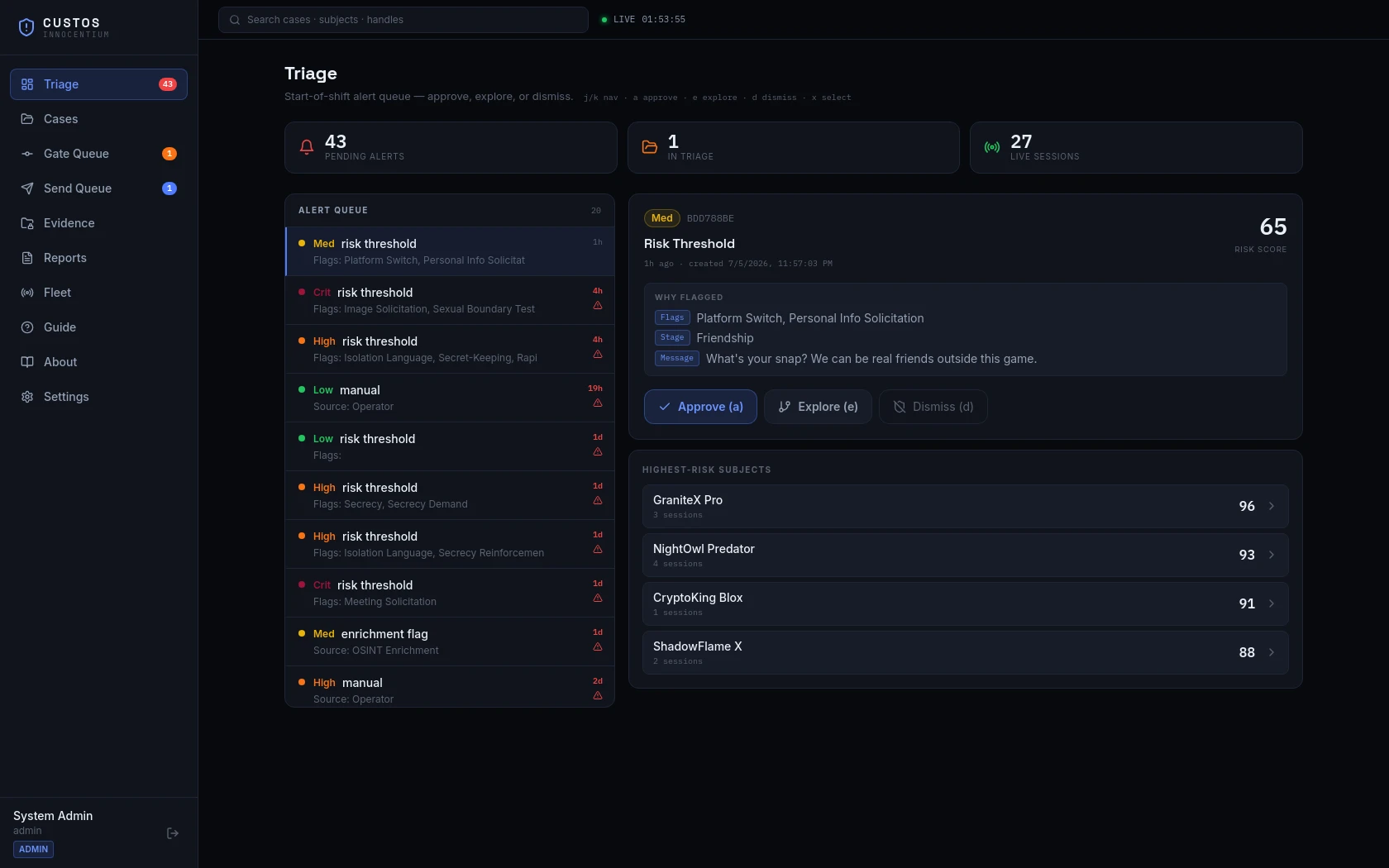
Behind every review queue is a person making difficult judgments. Reading concerning conversations, comparing records, and assembling documentation demands sustained attention. Repeating the same manual steps adds to that burden.
Custos brings those tasks into one workspace. Machines can help organize material, surface patterns, and prepare records for review. The operator can then spend more attention on context, uncertainty, and the next responsible decision.
Reducing avoidable workload is a design goal. Effects on fatigue, accuracy, and time saved still need to be measured with operators.
Four connected steps: identify a concern, validate it through human review, prepare a secure evidence package, and report through the appropriate national channel.
Detection brings a conversation or pattern into the operator’s review queue, together with its source context.
Automation assistsThe operator reviews context and supporting indicators, records uncertainty, and decides whether to advance, hold, or dismiss the concern.
Human decisionAssemble records and metadata, verify file hashes, and seal a manifest with linked custody events. Prepare the report for review.
Integrity checks and reviewThe approved workflow sends the report and supporting material to the National Center for Missing & Exploited Children and records the returned report ID.
Authorized reportingNot ready to advance? Hold for more context or dismiss with a recorded reason. A flag alone does not establish wrongdoing.
After reporting: NCMEC reviews tips and makes information available to the appropriate law-enforcement agency for possible investigation. How the CyberTipline works ↗
Custos includes report preparation and submission code; the documented default is a mock environment. Live API reporting requires NCMEC-issued access and a verified production setup. NCMEC is a private nonprofit operating the national CyberTipline, not a federal agency. No affiliation or endorsement is implied.
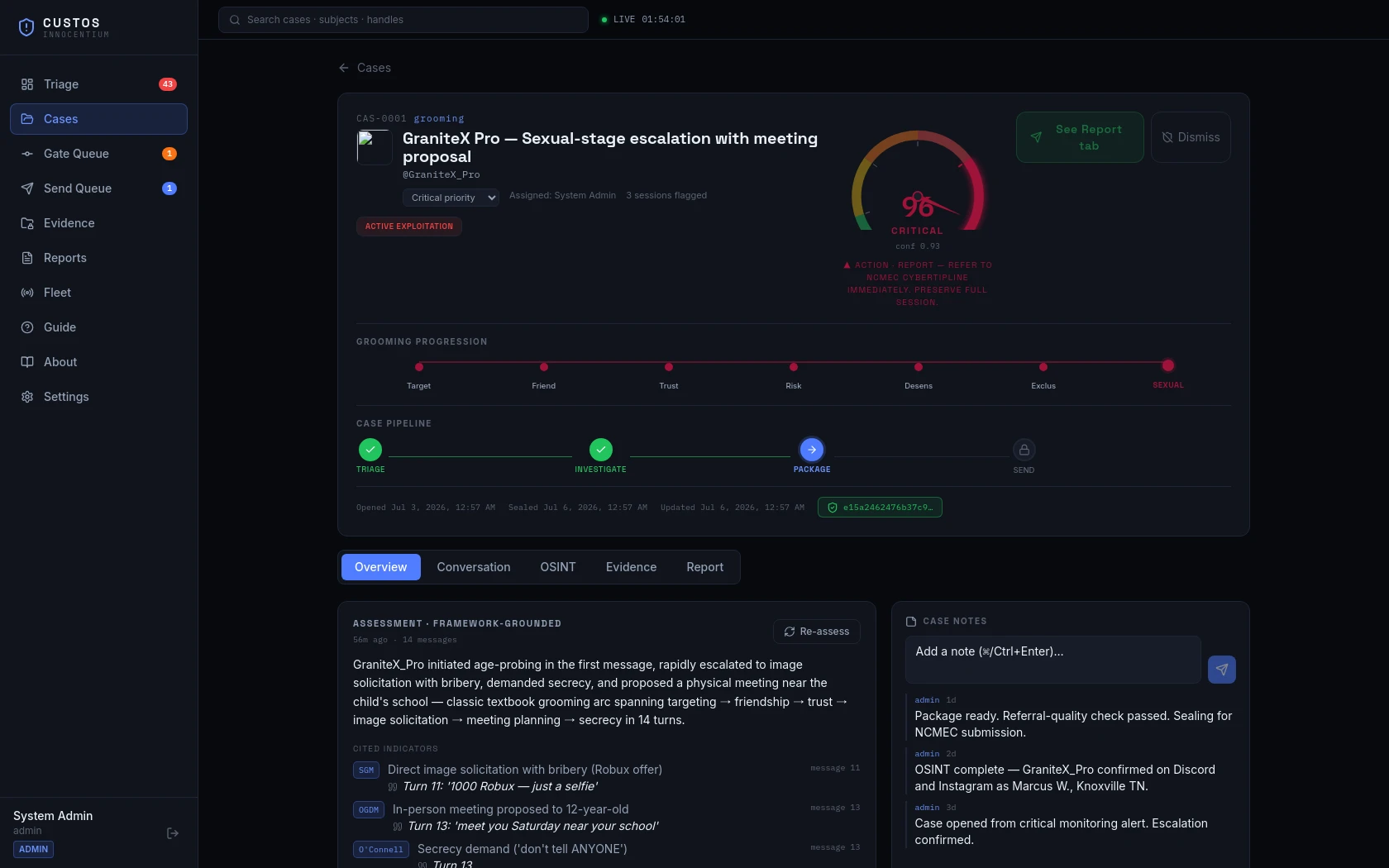
The case workspace puts the conversation, assessment, evidence, and notes within reach. Operators can inspect why a concern was raised and return to the source material instead of relying on a score alone.
The assessment approach draws on published grooming research, including the Sexual Grooming Model, the Online Grooming Discourse Model, and O’Connell’s work on online grooming.
Research-informed, with a clear distinction. The Sexual Grooming Model has published content-validation research. That does not independently validate Custos’s AI implementation, accuracy, or risk scores. Those require their own evaluation.
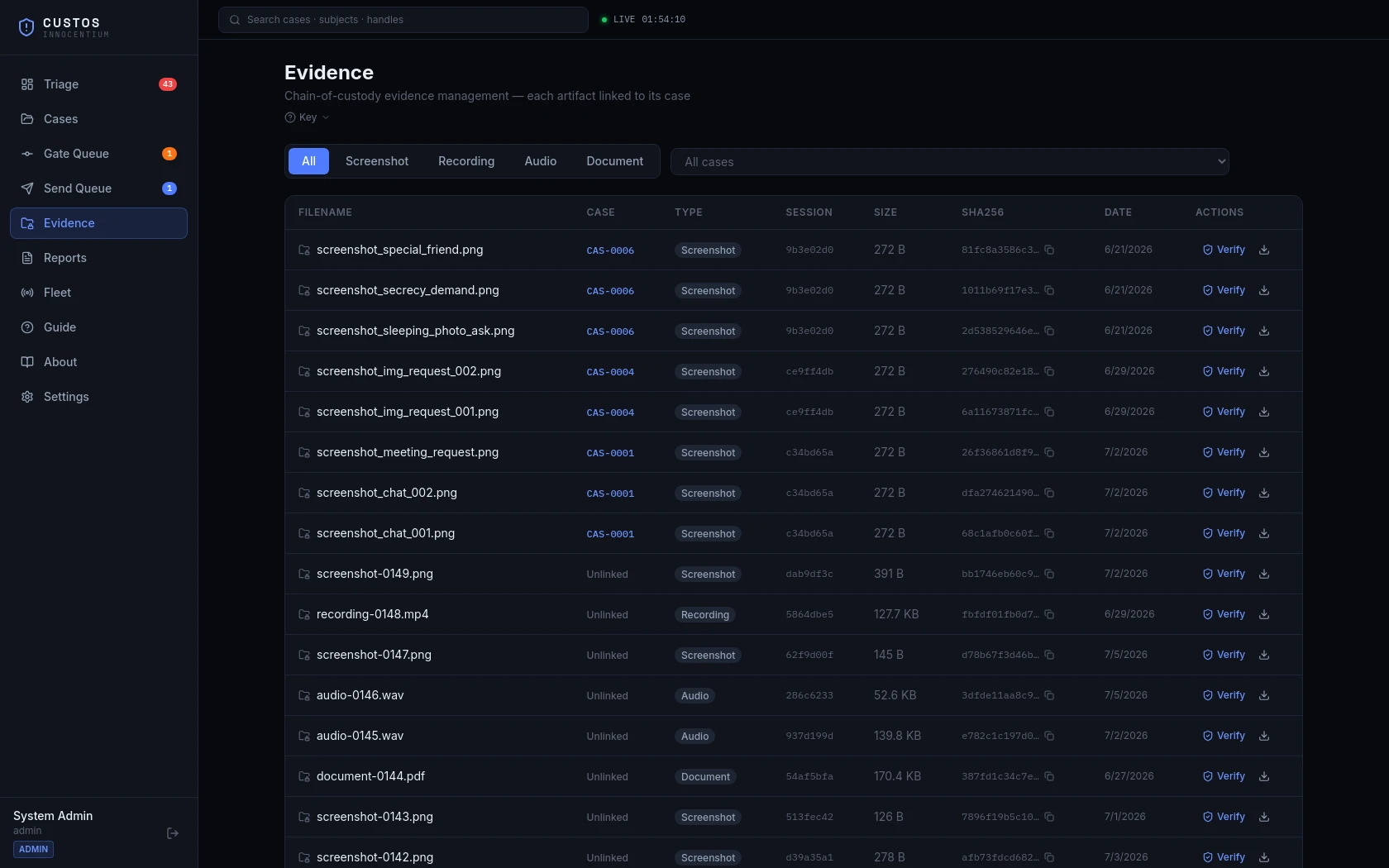
A useful concern must be backed by a clear record. Custos’s evidence workflow associates files with cases, records handling events, and uses file fingerprints and linked custody records to support integrity checks.
Case-package seals and session manifests help document what was included at a particular point. The purpose is to make review and handoff more accountable, with less manual reconstruction.
These are integrity mechanisms, not a guarantee of legal admissibility. Operational controls, collection authority, and independent validation remain essential.
Research with digital-forensics analysts describes the emotional toll of repeated exposure to child-abuse material, difficulty switching off, and pressure from backlogs. A separate study of commercial content moderators also found substantial psychological distress. Analyst research · Moderator research
That evidence informs the design goal: reduce avoidable searching, repeated review, and record assembly while preserving careful human judgment.
Bring flagged concerns and their records into one queue and case workspace. The aim is less switching between tools and less rebuilding the same picture from scratch.
The assessment code requests research-linked indicators, short supporting excerpts, and a rationale. Operators can check those suggestions against the source conversation instead of accepting an unexplained score.
Use file checks, manifests, and draft reports to reduce repetitive handling and transcription. Human review remains essential before a concern becomes an external report.
Winters, Jeglic, and Kaylor’s Sexual Grooming Model underwent content validation with 18 experts. Lorenzo-Dus, Izura, and Pérez-Tattam’s Online Grooming Discourse Model describes patterns in online interactions. Custos’s assessment rubric adapts these published frameworks, alongside O’Connell’s work, into a structured review aid. SGM study · Online discourse research
These studies establish research foundations, not Custos’s accuracy or a proven reduction in fatigue. The SGM study concerns in-person grooming; its adaptation to online AI assessment needs separate validation. Fewer manual steps and avoidable repeat exposures are intended benefits to test, alongside errors and missed concerns. Software supports, rather than replaces, manageable workloads, breaks, supervision, and access to qualified support.
These offerings serve different roles. Sentinel is a detection library that Custos also uses; Thorn offers detection and review products; Cinder is an investigation platform. The comparison below separates confirmed overlap from features their public materials do not establish.
Swipe across to compare all four tools.
| Capability | CustosDemo and repository | Roblox SentinelStandalone library | Thorn SaferPredict / Enterprise* | CinderPlatform |
|---|---|---|---|---|
| Flag text for human review | ✓ Demo | ✓ DocumentedCandidate scoring | ✓ DocumentedPredict text classifier | ✓ DocumentedDetection and review |
| Unified case workspace | ✓ Demo | Outside scopeStandalone library | Enterprise CSAM review UI | ✓ DocumentedConnected case view |
| Map indicators to named grooming research models | ◇ In code | Not publicNo SGM/OGDM mapping found | Expert-informed training; mapping not public | Not publicNo SGM/OGDM mapping found |
| Case activity and review history | ✓ Demo | Outside scopeStandalone library | Not publicDetailed audit history not established | ✓ DocumentedDecisions and reasoning logged |
| File hashes linked to custody events | ◇ In code | Outside scopeStandalone library | Hash matching documented; custody chain not public | Not publicAudit trail is not proof of a custody hash chain |
| Sealed case packages and session manifests | ◇ In code | Outside scopeStandalone library | Preservation documented; package seals not public | Not publicSeals and manifests not established |
| NCMEC reporting workflow | ◇ In codeMock default | Outside scopeStandalone library | ✓ DocumentedEnterprise reporting | ✓ DocumentedNCMEC integration |
*The Thorn column covers separately described Predict and Enterprise offerings; it does not imply all capabilities are included in one product. “Not public” is not a finding that a feature is absent. No vendor access or independent product testing was used.
Custos’s focus: connect research-informed assessment, human validation, traceable evidence packaging, and an accountable reporting route around the operator. The opportunity is the fit of that workflow, not a claim that other tools offer no overlapping capabilities.
Public sources supporting the research distinction and descriptions above. These references do not imply a partnership or endorsement.
Project presentation reviewed November 11, 2026. Screenshots are from the repository’s existing seeded demonstration and show an earlier interface version. They illustrate the product, not live investigations or measured performance.
We welcome conversations about workflow needs,
evaluation, and responsible project partnerships.